
This post contains affiliate links. If you purchase through these links, I may earn a small commission at no extra cost to you.
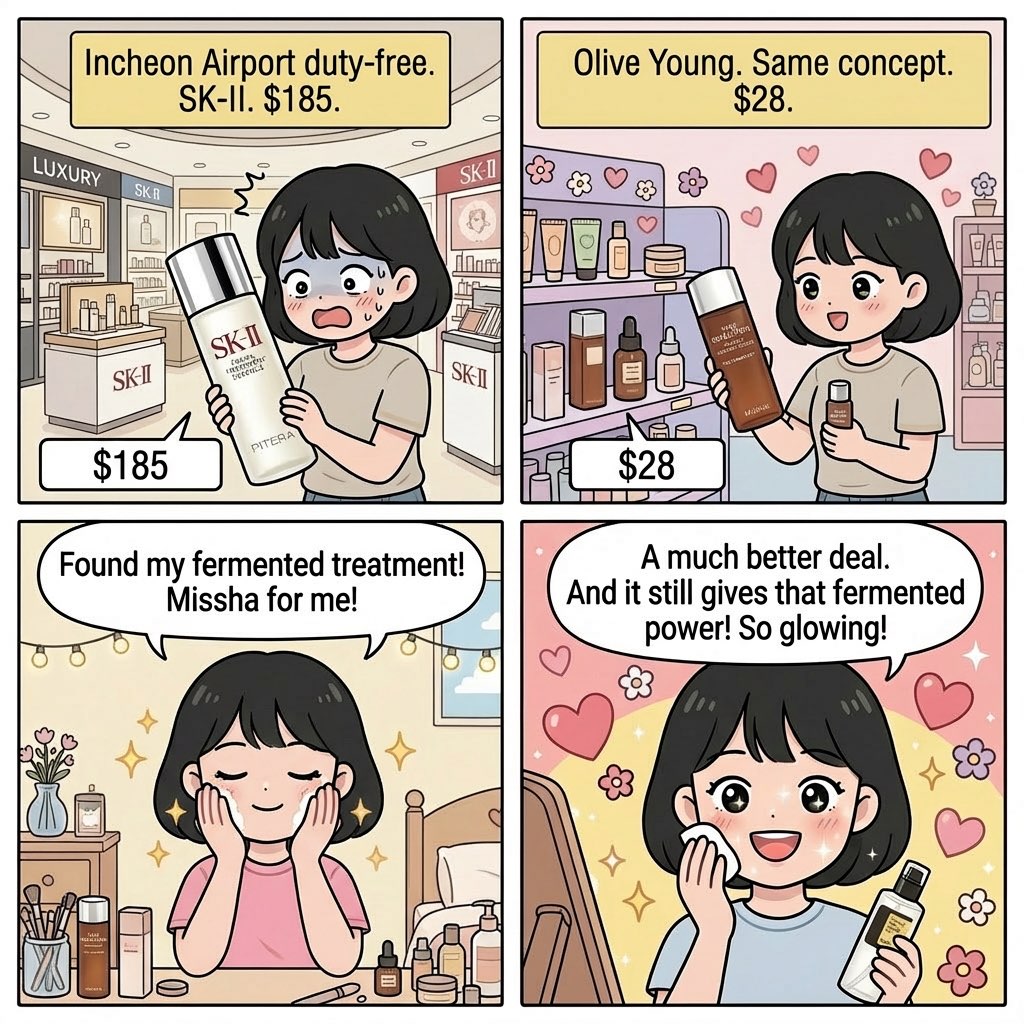
Incheon Airport duty-free, 2019. I’m holding a 75ml bottle of SK-II Facial Treatment Essence in one hand and my phone calculator in the other. The number says ₩210,000. That’s roughly $155. The duty-free lighting is flattering and cold and the sales associate has been standing patiently for four minutes while I do the math on whether I am the kind of person who spends ₩210,000 on a bottle of fermented water.
I am not. I put it back.
A month later at Olive Young in Sinchon, I found the Missha Time Revolution First Essence on the shelf next to the same category label: “first essence, fermentation-based, skin prep before toner.” The price was ₩33,000. I bought it without the four-minute calculator session.
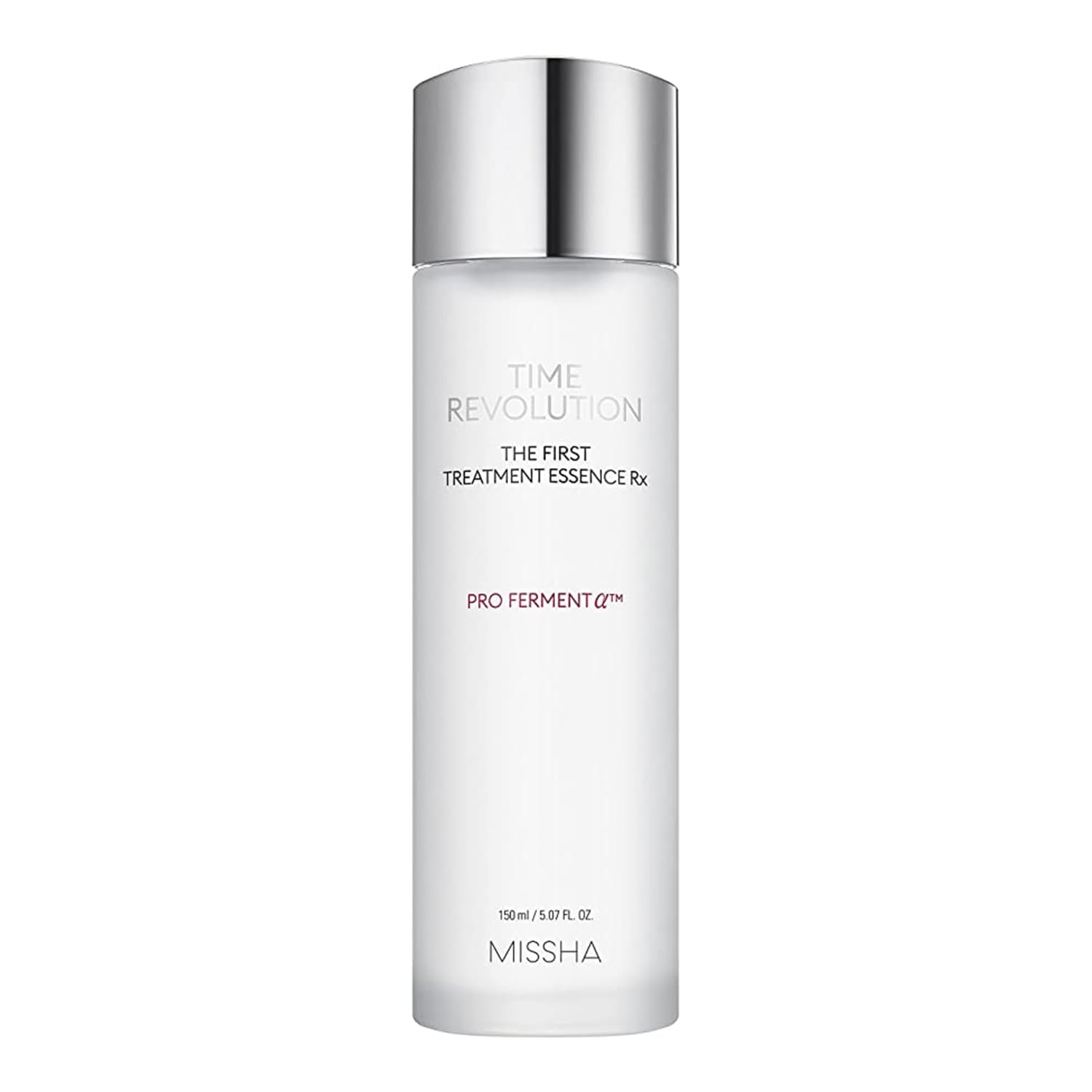
That was six years ago. I’ve used the MISSHA Time Revolution The First Essence RX 4th Generation through three apartments, two job changes, one full SK-II trial month, and six Seoul winters. I know what this product does, where it earns its price, and what competitors aren’t telling you about the SK-II comparison.
Quick Verdict — Missha Time Revolution First Essence RX
What works
- Makes your entire subsequent routine absorb better — this is its actual job
- 4th Gen RX adds peptide complex missing from earlier versions
- SK-II hydration results at 1/6 the cost
- Fragrance-light, no-tacky lightweight texture
- Visible improvement in dry patch texture over 3–4 weeks
What doesn’t
- Fermentation smell — real, dissipates in 60–90 seconds, but daily
- No visible results for 2–4 weeks — patience required
- Not a brightening product — SK-II wins that specific category
- $34 on Amazon vs ₩33,000 ($24) at Olive Young — import premium
- 150ml goes faster than it looks if you’re generous with application
Best for: Dry + dehydrated skin · First essence step in Korean layering routine · SK-II price shock refugees
Verdict: 88/100. If you’re building a Korean skincare routine and want a fermented first essence that actually works without spending ₩210,000, this is the answer.
Missha Time Revolution vs SK-II: Is It Actually a Dupe? (Honest Side-by-Side)
Let me answer this directly because most reviews dance around it: no, it is not a chemical dupe. It is a functional alternative targeting the same result by a different mechanism. That distinction matters — here’s why.
SK-II Facial Treatment Essence: 90%+ galactomyces ferment filtrate. Galactomyces is a specific yeast strain that produces a filtrate rich in B vitamins, amino acids, and niacinamide-adjacent brightening compounds. This is why SK-II’s primary visible benefit is translucency and skin tone evenness — the galactomyces filtrate has documented effects on melanin production and uneven pigmentation. Korean dermatologists who recommend SK-II are mostly recommending it for skin tone, not dehydration.
Missha Time Revolution RX 4th Gen: Double yeast fermentation — a two-stage process (cold fermentation, then warm) yielding a different nutrient profile than single galactomyces fermentation. Missha’s ferment is higher in certain enzymatic byproducts and lower in the galactomyces brightening compounds. This product’s primary benefit is hydration, barrier function, and making subsequent skincare layers absorb more efficiently. It doesn’t brighten the way SK-II does. It makes your whole routine work better.
| Missha Time Revolution RX | SK-II FTE | |
|---|---|---|
| Fermentation type | Double yeast (cold + warm) | Single galactomyces ferment (90%+) |
| Primary benefit | Hydration + absorption prep for subsequent layers | Brightening + skin tone evenness + hydration |
| Brightening effect | Minimal | Significant (documented) |
| Hydration/barrier | Strong — this is the product’s core function | Good, but secondary to brightening |
| 4th Gen “RX” addition | Peptide repair complex (new in this gen) + soothing complex | No equivalent designation; formula is largely unchanged |
| Smell | Fermented/sake note, dissipates in 90 seconds | Similar ferment note, slightly milder |
| Price | ~$34 Amazon / ₩33,000 Olive Young | ~$185 / ₩210,000 duty-free |
Bottom line on the dupe question: If you buy Missha expecting SK-II’s brightening effect, you’ll be disappointed. If you buy it as a hydrating first-step essence that makes everything after it work better — and you’re not specifically chasing skin tone evenness — you’ll get 90% of the SK-II benefit at 18% of the price. My SK-II month and my Missha month ended at skin that looked comparable in the mirror. The SK-II month cost ₩175,000 more.
See Missha Time Revolution pricing on Amazon →
What the “4th Generation RX” Actually Means (Most Reviews Skip This)
This is the underreported detail in English-language reviews: the “RX” designation in the fourth generation is not just marketing versioning.
The first three Missha Time Revolution generations were primarily focused on the fermented yeast filtrate as the sole active. The 4th Gen RX adds two layers the previous versions didn’t have:
- Peptide repair complex: A combination of signaling peptides that support collagen production and skin barrier reinforcement. This pushes the product from “hydration + absorption prep” into light anti-aging territory. First essences traditionally don’t contain peptides — they’re absorption-prep steps, not treatment steps. Missha’s inclusion of a peptide complex in the 4th gen is what makes this formulation meaningfully better than the 3rd gen for people in their late 20s and 30s using this as a long-term skin investment.
- Soothing complex: Added after Korean community feedback that the 3rd gen formula was occasionally causing sensitivity around the nose and cheek area for sensitive skin types. The 4th gen is noticeably less likely to cause this reaction.
If you tried an earlier generation and found it underwhelming or slightly irritating: the 4th gen RX is worth re-testing. The improvement over 3rd gen is real and specific, not just packaging.
How Missha Time Revolution First Essence Performs: Real Results Over 3 Seoul Seasons
The most important thing to know about this product before buying it: the results are invisible until they’re not.
The product’s mechanism isn’t changing your skin directly. It’s changing how receptive your skin is to everything you apply after it — your toner absorbs more evenly, your COSRX snail mucin essence sinks in faster, your moisturizer does more. That’s the Korean 기초 관리 (base care) concept: invisible infrastructure that makes the whole system function better.
Week three. I was getting ready for a client presentation in Gangnam — the kind of day where I actually apply foundation properly instead of just swiping something on. I reached for my cushion, started applying, and stopped. The texture was different. The product wasn’t sitting on top of my skin the way it normally does — it was adhering. I’d used less coverage and somehow had more. I stood in front of my bathroom mirror for about 20 seconds longer than usual, trying to figure out what I’d changed. I hadn’t changed anything except adding this essence step three weeks earlier. That was the moment I understood what a first essence actually does.
October in Seoul, when the building heating turns on for the first time in autumn: the air quality changes overnight. Central heating with zero humidity control. You go to sleep with normal skin and wake up with the kind of tight, faint-creasing dryness that is specific to heated rooms in Korean winters. It’s that seasonal shift — the first week of heating — when you feel most clearly what your first essence is doing. That week, applying the Missha is the difference between 9pm skin that’s cracking slightly at the corners of the eyes and 9pm skin that feels intact.
I restarted after a two-week gap last autumn — ran out, delayed reordering. By day four without it, I could feel the routine underperforming. The toner wasn’t absorbing evenly. The snail mucin was taking longer to sink in. When I restarted, the routine recalibrated within three days. That is not placebo. That’s infrastructure.
The Fermentation Smell — Because Pretending It Doesn’t Exist Helps No One
It smells like fermentation. Specifically, like a mild makgeolli or sake — a yeasty, slightly fermented grain scent. It dissipates within 60–90 seconds of application. It doesn’t linger on skin. But every morning and evening when you open the bottle and apply, it is present.
SK-II has the same issue. Anyone telling you SK-II is fragrance-neutral hasn’t smelled it directly. Both products smell like what they are: fermented biological material. Missha 4th gen and SK-II are comparable in smell intensity — if anything the new Missha RX generation has dialed it back slightly.
In the Korean skincare community, fermentation smell is considered a quality signal — evidence of real, active ferment rather than a synthetic approximation. That framing is a choice. If you’re not in that frame, it’s a product that smells unusual for 90 seconds twice a day. Decide accordingly before purchasing.
Buy Missha Time Revolution on Amazon →
Missha Time Revolution Honest Downsides: 6 Years, No Sugar-Coating
1. Results take 2–4 weeks minimum, and they’re subtle. The improvement is in how your skin feels and how your other products perform — not a visible before/after. If you’re looking for dramatic change in a week, this is the wrong product category. First essences are not serums.
2. It won’t brighten your skin tone. That’s SK-II’s edge. Galactomyces ferment has documented brightening effects. Missha’s double yeast ferment does not — it hydrates and preps, it doesn’t correct pigmentation. If skin tone evenness is your goal, this isn’t the right product.
3. $34 Amazon pricing vs ₩33,000 Olive Young. At current exchange rates, you’re paying about $10 in import markup. That’s the standard K-beauty Amazon premium — not Missha specifically, just what shipping from Korea costs. Subscribe & Save on Amazon brings it to around $29–30.
4. Earlier generations (1st–3rd gen) are significantly worse. If you read any pre-2022 review of Missha Time Revolution and it’s negative about texture or sensitivity — that review may be about an older formula. The 4th Gen RX is genuinely better. Don’t let old reviews make this decision for you.
Is Missha Time Revolution First Essence Worth It? Final Verdict
Worth it if: you have dry or dehydrated skin, you’re building a Korean layering routine, and you’re willing to wait three weeks for results that work at the infrastructure level rather than the surface level. This is not a “feel it on day one” product. It’s a “three weeks later my foundation applies differently and I can’t figure out why” product. That’s the category.
As a SK-II alternative specifically: yes, for hydration and absorption purposes, Missha covers 90% of the territory at 18% of the price. Not a brightening dupe. A hydration and skin-prep powerhouse at a rational price point.
Six years. Three Seoul apartments. Six winters with the heating on. Same step, same product, same position in the routine — first thing after cleansing, before everything else. That’s the answer.
Missha Time Revolution The First Essence RX 4th Gen
4.5 stars · 150ml · Double fermentation · ~$34 on Amazon
Seoul-tested · 6 years daily use · SK-II alternative for hydration
Get It on Amazon →Affiliate link — I earn a small commission at no extra cost to you.
Missha Time Revolution First Essence FAQ
Is Missha Time Revolution a SK-II dupe?
Functional alternative, not a chemical dupe. Missha uses double yeast fermentation; SK-II uses galactomyces ferment (single). Missha delivers comparable hydration and skin-prep benefits. SK-II is better for brightening and skin tone. If brightening is your goal, SK-II. If hydration and better routine absorption are your goal, Missha at 1/6 the price.
What’s new in the 4th Generation RX?
Two additions: a peptide repair complex (light anti-aging, not in previous gens) and a soothing complex after community feedback about 3rd gen sensitivity. The RX designation is meaningful — it’s a substantively improved formula, not just packaging versioning.
Why does it smell like that?
Real yeast fermentation produces aromatic byproducts — the sake/makgeolli scent is a sign of active ferment, not a manufacturing flaw. Dissipates in 60–90 seconds. SK-II smells similar. Korean skincare communities consider this a quality indicator.
How do you use Missha Time Revolution First Essence?
After cleansing, before everything else. 2–3 pumps onto palms, press against face for 10–15 seconds, then pat. The palm-press method — not cotton pad, not swipe — delivers ferment at body temperature. Missha specifically recommends this for optimal absorption.
How long until I see results?
2–4 weeks, and the results are indirect — foundation applies more evenly, moisturizer absorbs faster, skin feels more resilient. It’s not a surface treatment; it’s absorption infrastructure. If you’re not noticing this at week 4, you may need more than one layer (2–3 pumps, not 1).
Where’s the best price?
Olive Young in Seoul: ₩33,000 (~$24). Amazon US: ~$34. Subscribe & Save brings Amazon closer to $29–30. YesStyle sometimes runs it at $26–28 with coupon codes.
More from the Seoul skincare shelf: COSRX Snail Mucin 96% Review · ANUA Heartleaf 77 Toner Review · Some By Mi AHA BHA PHA Toner Review
I’m Minji — writing from Seoul, where I’ve been watching the fermentation skincare category since before it went global. I put the SK-II back. I don’t regret it.