
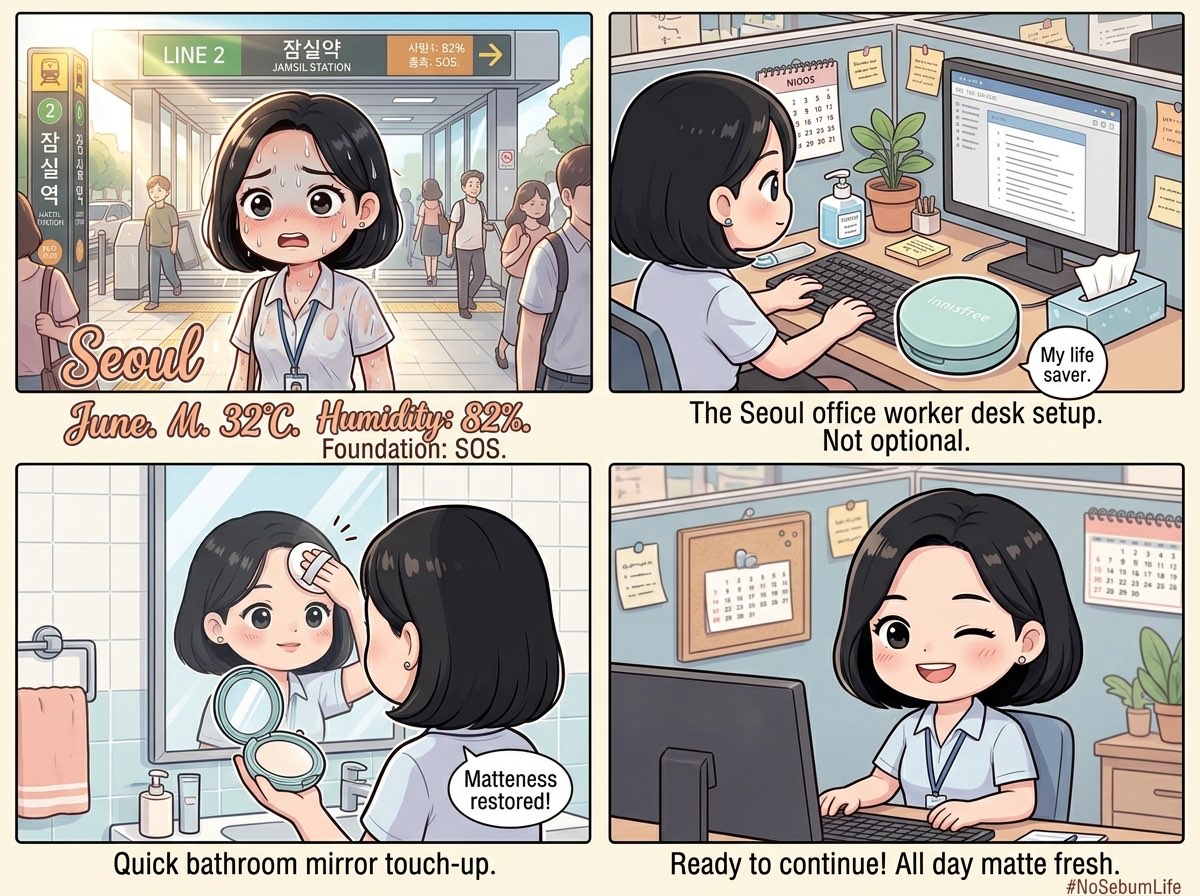
June in Seoul is not a “maybe bring setting powder” situation. It’s a “the setting powder IS your makeup” situation.
I walked out of Jamsil Station exit 8 last summer at 8:47am. It was 32°C. Humidity 82%. By the time I reached my office building — a four-minute walk — my tinted moisturizer had already migrated into my pores. My nose looked like an oil slick on legs.
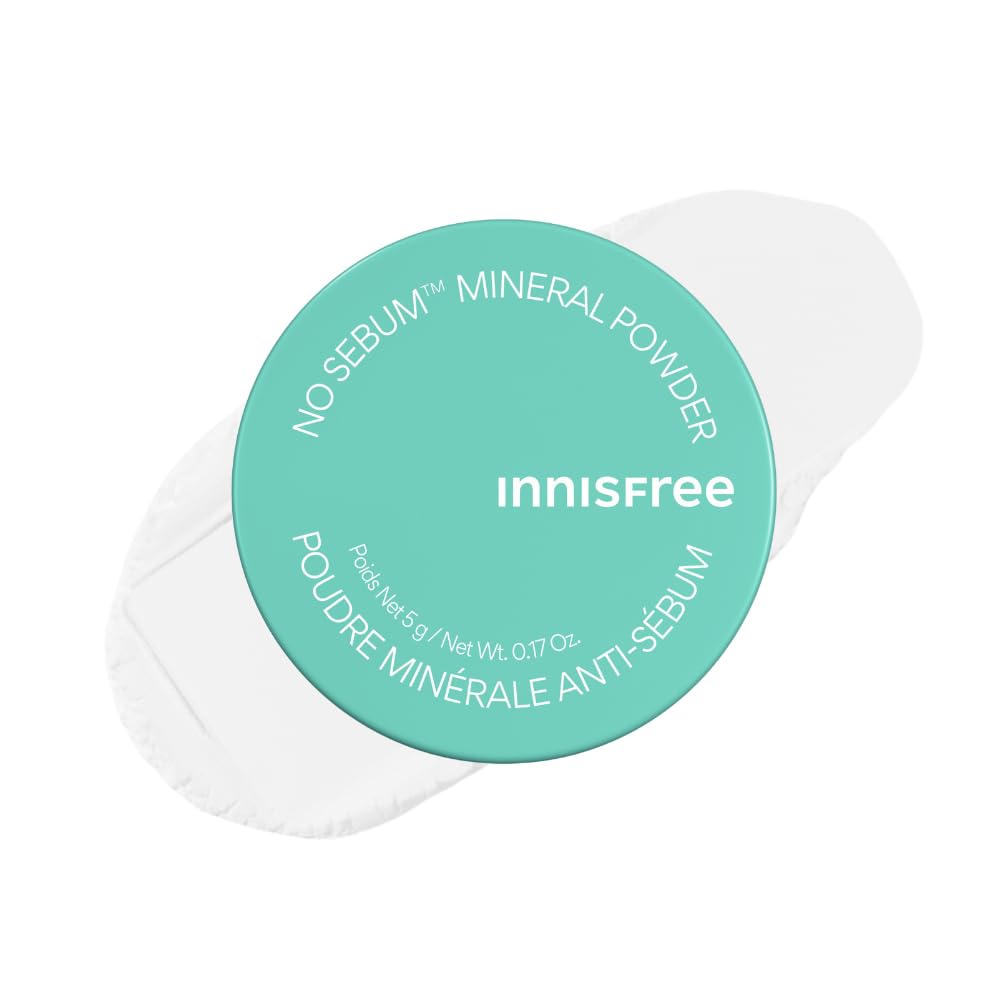
I’ve been using the Innisfree No-Sebum Matte Mineral Powder in that exact climate for three years. I know exactly what it does well, what it doesn’t, and who will regret buying it. That’s what this review is actually about — not the marketing copy.
Quick Verdict — Innisfree No-Sebum Mineral Powder
What works
- Absorbs oil actively for 6–7 hours (oily skin, humid conditions)
- Jeju volcanic ash formula — not just talc
- Fragrance-free, minimal ingredients
- Best-value K-beauty setting powder at this price
- Doubles as travel touch-up, dry shampoo, matte lipstick setter
What doesn’t
- White cast risk — real, especially on medium-deep skin tones
- Only 5g — finishes faster than you expect
- Puff applicator is mediocre; upgrade to a fluffy brush
- Doesn’t work on dry skin — emphasizes dry patches
- Zero coverage — purely a setting/touch-up tool
Best for: Oily + combination skin · Summer wear · Office touch-ups · Anyone surviving Korean humidity
Verdict: The most efficient oil-absorbing setting powder in K-beauty under $15. If you match the target profile (oily skin, need on-the-go mattifying), stop second-guessing and buy it.
Who Should (and Shouldn’t) Buy Innisfree No-Sebum Mineral Powder
Before anything else: this powder has a specific target profile. Using it outside that profile is the reason most negative reviews exist.
| Skin type | Result | Buy? |
|---|---|---|
| Oily skin | Active oil absorption, 6–8hr wear, cleanest result | Yes — this is made for you |
| Combination skin | Works well on T-zone; use light hand on dry cheek areas | Yes — with technique |
| Normal skin | Fine for setting; may look slightly matte/flat by end of day | Situational (summer yes, winter maybe not) |
| Dry skin | Settles into dry patches, emphasizes texture, looks dusty by afternoon | No — skip this |
Also relevant: this powder is translucent, but “translucent” is doing some work here. On lighter skin tones (think NC10–NC20 in MAC shade range) it’s invisible. From NC30 upward, the white cast from the silica becomes visible in certain lighting — particularly in photos and flash photography. Korean beauty communities noticed this early on, and it’s the most underreported downside in English-language reviews.
Innisfree No-Sebum Mineral Powder Review: The Formula Breakdown
Innisfree launched this in 2011 specifically for Seoul’s summer humidity — at ₩6,000, deliberately priced to democratize a category that luxury Korean brands had been charging ₩30,000+ for. The brand (owned by Amorepacific) wanted to own the daily-use tier. They succeeded.
The formula uses Jeju volcanic minerals — specifically 화산 회토 (volcanic ash clay) — alongside kaolin and silica. In 2019, the formula was quietly updated to remove an ingredient that was causing sensitivity in a subset of users. If you have older reviews in mind where people mentioned redness, those predate the reformulation.
How the three actives work in layers:
- Jeju volcanic ash (10% concentration): High surface area mineral that actively draws oil to the powder, rather than just sitting on top of skin. Active absorption, not passive.
- Kaolin: Gentle foundational oil absorber. Non-irritating, safe for sensitive and acne-prone skin.
- Silica: Creates the soft-focus blur and light diffusion — what makes skin look smooth-matte instead of flat-matte. Also the source of white cast at higher concentrations.
The 5g quantity problem: At 5g, this looks like it’ll run out in a month. In practice it lasts 3–4 months with daily use (setting + one touch-up per day). But compared to, say, a 12g Western setting powder, you’re paying a higher price per gram — about $2.40/g vs $0.50–1.00/g for similar Western powders. The formula justifies that premium for oily skin. If you’re normal-to-dry, it doesn’t.
How to Use Innisfree No-Sebum Mineral Powder Correctly (Most People Get This Wrong)
Application technique matters more with this powder than most. Here’s the breakdown:
First: Ditch the puff for daily use. The included puff presses product into pores rather than dusting evenly. It’s mediocre even by K-beauty puff standards. A fluffy powder brush gives a significantly better result — lighter coverage, no milia risk, no powder concentration in pore areas.
Setting after sunscreen vs. after cushion:
- On top of cushion foundation: Apply with light circular motion, one layer. Result: matte, pore-blurring, holds for 5–7 hours in normal conditions.
- On top of sunscreen (no foundation): Dust lightly to reduce SPF tackiness. This is a genuine Korean beauty tip — setting powder on SPF helps it dry down faster and extends wear. One light layer is enough; two layers will make the SPF feel stripped.
- Touch-up mid-day on existing makeup: Tap puff or brush once into powder, tap off excess, then press (don’t rub) onto oily areas. This prevents disturbing existing makeup layers while absorbing fresh sebum.
Korean dermatologists I’ve spoken with note: the rolling-and-lifting motion (not pressing flat) also reduces the milia risk that some users report. You’re depositing powder on top of skin, not into pores.
Best Setting Powder for Oily Skin in Korea? How No-Sebum Compares
This is where English reviews consistently underdeliver. Vague comparisons don’t help. Here’s the concrete breakdown:
| Product | Price | Oily skin wear (humid) | White cast | Puff quality | Best for |
|---|---|---|---|---|---|
| Innisfree No-Sebum | ~$12 / ₩8,500 | 6–7 hrs | Moderate risk NC30+ | Mediocre (use brush) | Oily skin, budget pick |
| Banila Co Prime Primer Finish | ~$20 / ₩15,000 | 6–8 hrs | Low risk | Better than No-Sebum | Combo skin, photo-friendly |
| Etude Sunprise Setting Powder | ~$14 / ₩10,000 | 5–6 hrs | Low-moderate | Decent | Slight glow finish, combo skin |
| Laura Mercier Translucent | ~$48 | 7–9 hrs | Very low | Excellent (velour) | Any skin type, professional finish |
Verdict on the comparison: Banila Co is genuinely better for combo skin and photo-safe performance. If you’re doing content creation or meetings on camera, spend the extra $8. For straight oil control on oily skin in humid conditions — No-Sebum matches Banila Co’s results at 60% of the price. Laura Mercier wins overall quality but costs 4x as much for a difference that shows mainly in studio lighting.
If your main concern is oily skin and summer wear, No-Sebum is the straightforward buy at this price point. If you’re combo or want camera-ready results, go Banila.
Honest Downsides: What Competing Reviews Don’t Tell You
Reviews that only tell you the good things are useless. Here’s what actually matters:
1. White cast is a real issue above NC30. The silica concentration that creates the blur effect also creates a white cast in flash photography and some overhead lighting situations. Korean beauty communities identified this in the early reviews, but English-language content has mostly ignored it. If you’re NC30+ in MAC, test this in flash before an event.
2. The puff applicator is genuinely not great. It applies too much product in concentrated patches rather than diffusing evenly. Every regular user I know in Seoul either switched to a fluffy brush or decanted the powder into a separate brush compact. The puff works for quick touch-ups in a pinch — but for your morning application, use a brush.
3. 5g disappears faster than you think in summer. When you’re doing a morning set AND a midday touch-up daily through June–August, the 5g goes in about 8–10 weeks, not the 3–4 months of normal winter use. Budget accordingly — if you’re in a humid climate, plan on 4–5 units per year, which changes the cost math.
4. It stops working on already-saturated skin. If your T-zone has been shining for four hours and you’re trying to use this as a rescue, it’ll layer on top of the oil rather than absorb it. This is a setting powder, not a correcting powder. Apply it on clean or recently blotted skin for best results.
Here’s the thing, though: knowing all four of these downsides, I still keep this at my office desk and have for three years. Because none of them change the core function — for oily skin in humid conditions, applied correctly with a brush, this performs better than anything else at this price. That’s still worth $12 →
Innisfree No-Sebum Mineral Powder Broke Me Out? Reddit’s Debate, Answered
This question comes up regularly on r/AsianBeauty and in Korean beauty communities. Direct answer:
The powder itself is non-comedogenic. Jeju volcanic ash and kaolin are both skin-safe minerals with no documented pore-clogging mechanism. The formula is fragrance-free and has minimal irritants.
The puff applicator is the more likely culprit. Pressing the included puff firmly into skin can push product into pores, and a rarely-cleaned puff accumulates bacteria. If you’re breaking out: switch to a clean brush, clean your applicator weekly, and check whether the breakout pattern corresponds to where you’re pressing the puff hardest (typically nose bridge and forehead crease).
Pre-2019 formula vs. current: Earlier versions had an ingredient that caused sensitivity reactions in a subset of users — particularly around the nose area. If your experience is from before 2020, the current formulation is different.
The realistic verdict: For most oily and combination skin types, this powder will not cause breakouts when applied correctly. For sensitive and acne-prone skin specifically, it’s still lower-risk than most setting powders at this price point, because it’s fragrance-free and mineral-based.
Is Innisfree No-Sebum Mineral Powder Worth It? The Final Breakdown
Let’s make this binary, because the internet has too many “it depends” answers:
Worth it if: You have oily or combination skin. You live somewhere with humid summers. You need an on-the-go touch-up that fits in any bag. You’re spending on good skincare (a solid hydrating toner or essence layer) and need your makeup to actually stay on top of it.
Not worth it if: You have dry skin (full stop, don’t buy this). You’re above NC30 and do any kind of photography or video. You want a higher-quantity product per dollar.
Three years in Seoul summers, three years in my desk drawer in Yeouido. The Korea-made formula designed for Korea-level humidity is the most efficient thing at this job, at this price, that I’ve tested. That’s not marketing. That’s three June-August seasons of evidence.
Innisfree No-Sebum Matte Mineral Powder
4.5 stars · 5g · Fragrance-free · Jeju volcanic minerals · ~$12
For oily + combination skin · Seoul-tested through 3 summers
Buy on Amazon →Affiliate link — I earn a small commission at no extra cost to you.
Building your full routine? See my review of the Some By Mi AHA BHA PHA toner for the exfoliating step that makes setting powder work even better on oily skin.